
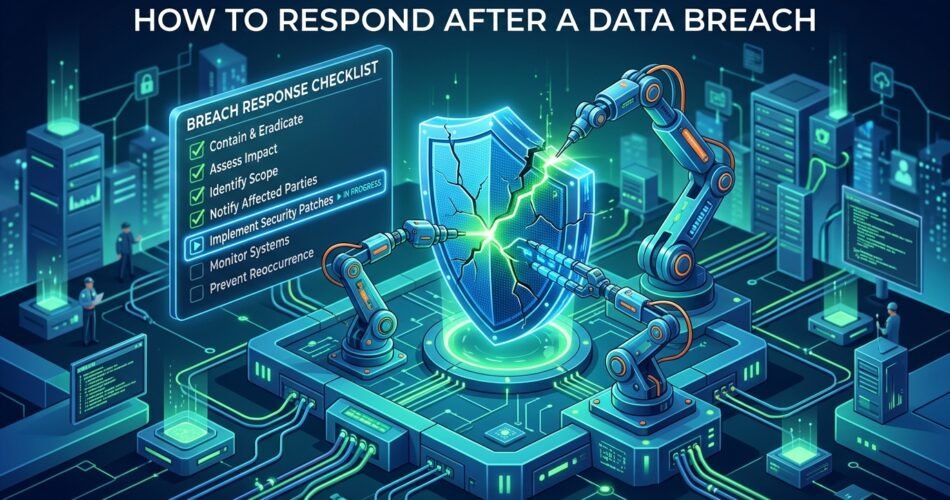
Somewhere right now, a database somewhere is being quietly copied by someone who has no business touching it. That’s not paranoia, it’s just the current baseline. More than 471 million victim notices were issued in the first half of 2026 alone, according to the Identity Theft Resource Center, putting this year on pace to break the record set just twelve months earlier. If your information hasn’t been caught up in a breach yet, the honest statistical reality is that it’s less a question of if than when.
That sounds grim, and it is, but it’s not a reason to throw up your hands. The gap between people who get seriously hurt by a data breach and people who barely notice usually comes down to a handful of protective habits, most of which take far less effort than people assume. This guide walks through what’s actually driving the current wave of breaches, and the specific, practical steps that make the biggest difference in keeping your personal data out of the wrong hands.
Why 2026 Is Shaping Up to Be a Record Year
Understanding the scale of the problem helps explain why casual security habits no longer cut it. The Identity Theft Resource Center recorded 1,803 data breaches in just the first half of 2026, compared to 3,321 for all of 2025, itself a record-breaking year. The organization’s leadership has pointed specifically to a surge in “mega breaches,” incidents affecting enormous numbers of people at once, as the primary driver behind the spike in victim notices.
Part of what’s changed is the sophistication of the attackers themselves. Cybersecurity researchers estimate that roughly one in six breaches in 2025 involved AI-driven attack techniques, with automated tools now capable of crafting more convincing phishing messages, probing for vulnerabilities at scale, and adapting in real time when an initial approach fails. This matters for individuals specifically because the old advice to “watch out for bad grammar in scam emails” has become far less reliable as a warning sign.
Understanding What Happens After Your Data Is Stolen
The Immediate Fallout
Once personal information is exposed in a breach, it doesn’t just sit quietly in a database somewhere. Stolen data routinely circulates on dark web marketplaces, where it gets bought, sold, and combined with other leaked datasets to build increasingly complete profiles of individual victims. A breach that exposes just an email address and password might seem minor on its own, but when combined with a separate leak containing your address or phone number, the combined profile becomes far more dangerous in the hands of a scammer.
The Longer-Term Risk
The financial cost of a serious identity theft incident tends to unfold over months rather than days, credit accounts opened in your name, tax refunds redirected before you file, or medical services billed to your insurance without your knowledge. This drawn-out timeline is exactly why prevention and early detection matter so much more than damage control after the fact. By the time many victims notice something is wrong, the fraudulent activity has often been running quietly for weeks.
Building Strong Password Habits That Actually Hold Up
Why Reused Passwords Are the Single Biggest Risk
If there’s one habit responsible for more personal data breaches than any other, it’s password reuse. When one service you use gets breached, and given the pace of breaches in 2026, eventually one will, criminals immediately test that same email and password combination against banking sites, email providers, and shopping accounts in a technique called credential stuffing. A single reused password can turn one company’s breach into a personal disaster across a dozen different accounts.
Making Password Managers Non-Negotiable
The realistic fix here isn’t memorizing dozens of complex passwords, it’s using a password manager to generate and store a unique, strong password for every single account. This single change eliminates the credential stuffing risk almost entirely, since a breach at one service no longer has any bearing on your accounts elsewhere. Security experts increasingly point to passkeys, a newer authentication method that replaces passwords entirely with device-based cryptographic keys, as an even stronger option where services support it, since there’s simply no password for an attacker to steal in the first place.
Multi-Factor Authentication Is No Longer Optional
Even a strong, unique password can be compromised through phishing, which is why multi-factor authentication has moved from a nice-to-have to an essential layer of defense. Requiring a second form of verification, a code from an authenticator app, a hardware key, or a biometric check, means that a stolen password alone isn’t enough for an attacker to get into your account. This single step blocks the overwhelming majority of automated account takeover attempts, even when your password has already been exposed somewhere.
It’s worth specifically prioritizing this protection on your email account above almost everything else, since email is typically the recovery method for every other account you own. An attacker who gains control of your email can often reset passwords across your entire digital life, which makes it one of the highest-value targets worth defending carefully.
Spotting Phishing in an Age of AI-Generated Scams
The classic advice to look for typos and awkward phrasing in suspicious emails has weakened considerably as AI tools make it trivial for scammers to write flawless, natural-sounding messages. What still holds up is scrutinizing the underlying request rather than the writing quality: unexpected urgency, requests to click a link and “verify” account details, or pressure to act immediately before you’ve had time to think it through. Genuine institutions rarely demand instant action through an unsolicited email or text message.
A particularly useful habit is verifying suspicious requests through a separate channel entirely. If a message claims to be from your bank, closing your laptop and calling the number on the back of your physical card, rather than any number or link in the message itself, sidesteps the entire manipulation regardless of how convincing the original message looked.
Limiting What You Expose in the First Place
Reducing Your Digital Footprint
Every account you create, every online form you fill out, and every service you sign up for adds another potential point of exposure if that company is ever breached. Periodically reviewing old accounts you no longer use and deleting them where possible shrinks the total surface area available to attackers, since data that no longer exists can’t be stolen. This is a slower, less glamorous defense than a password manager, but it meaningfully reduces long-term risk.
Being Deliberate About What You Share
Beyond formal accounts, the everyday information shared on social media and public profiles often provides exactly the details scammers need to answer security questions or impersonate you convincingly, birthdates, pet names, mother’s maiden name, and similar details that seem harmless individually but add up to a usable profile. Being more deliberate about what stays public, even on platforms that feel low-stakes, closes off one of the quieter avenues attackers use to build a convincing impersonation.
Monitoring for Trouble Before It Escalates
Credit Freezes and Monitoring Services
A credit freeze, which restricts access to your credit report so new accounts can’t be opened in your name without your explicit unlock, remains one of the most effective and underused protections available, and it’s typically free to set up with each of the major credit bureaus. Identity monitoring services add another layer by alerting you when your personal information appears in a new breach or shows up somewhere unexpected online, giving you a head start on responding before damage compounds.
Acting Quickly When You’re Notified
When a company you use discloses a breach, the instinct to ignore the notification because “these happen all the time now” is understandable but risky. Treating each notification as a prompt to change the affected password immediately, and to watch related accounts closely for unusual activity in the following weeks, closes the window of opportunity before an attacker has time to act on the exposed information.
Final Thoughts
Protecting personal data in 2026 isn’t about achieving some unrealistic state of total invulnerability, it’s about closing off the easiest, most common paths attackers rely on. Unique passwords managed through a password manager, multi-factor authentication on your most important accounts, a healthy skepticism toward urgent unsolicited requests, and a credit freeze sitting quietly in the background together account for the overwhelming majority of protection most people will ever need.
If this guide gave you a clearer sense of where your own habits could use a tune-up, share it with someone in your life who could use the reminder, or drop a comment with the step you’re tackling first. And if you want more practical, well-researched security guidance as the threat landscape keeps shifting, subscribe so the next update reaches you before the next breach does.

