
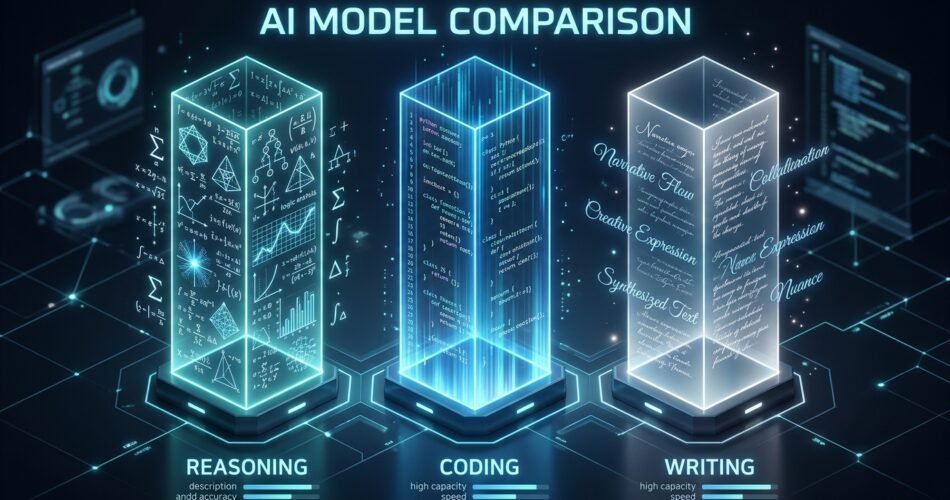
There was a time, not long ago, when picking an AI model meant picking the one everyone was already talking about. That era is over. Walk into any conversation about AI today and you’ll hear a half-dozen model names thrown around, each with its own devoted following and its own claim to being “the best,” and the honest truth is that none of them are lying. Different frontier models genuinely excel at different things, and the model that writes your best blog post might not be the one you’d trust to debug your production code.
This comparison cuts through the noise to look at how leading AI models actually stack up across three distinct jobs: reasoning through complex problems, writing functional code, and producing genuinely good prose. Understanding these differences isn’t just trivia for AI enthusiasts. It’s the difference between wasting time fighting a model that isn’t suited to your task and building a workflow that plays to each tool’s actual strengths.
Why One Model Can’t Win Everything
It’s tempting to want a single leaderboard with one model sitting at the top, but that instinct doesn’t match how these systems are actually built. Every frontier lab makes tradeoffs during training, choices about which capabilities to prioritize, how much reasoning depth to bake in versus how fast the model responds, and how heavily to optimize for code versus creative writing versus factual recall. Those tradeoffs show up clearly once you start comparing models across different task types rather than judging them on a single overall score.
Independent benchmarking efforts underscore just how tight this competition has become. One widely cited benchmarking index tracks hundreds of models across roughly ten different evaluation categories, and the gap between the top handful of frontier models is often described as narrow enough that the “best” choice depends heavily on the specific task rather than a fixed ranking. That nuance is exactly what gets lost when a headline just says “Model X wins.”
Comparing Reasoning Ability Across Models
What Reasoning Benchmarks Actually Measure
When people talk about a model’s reasoning ability, they’re usually referring to its performance on benchmarks that test multi-step logic, graduate-level scientific questions, and problems that require holding several pieces of information in mind at once rather than pattern-matching to something seen during training. These tests are designed specifically to be resistant to memorization, which makes them a reasonably good proxy for genuine problem-solving ability rather than just recall.
Where the Frontier Models Diverge
Across current frontier models, reasoning performance tends to cluster tightly at the very top, with the leading systems from Google, OpenAI, and Anthropic all posting strong scores on graduate-level science and advanced logic benchmarks. Where they tend to diverge is in how they reason. Some models are tuned to think longer before responding, effectively trading speed for depth on harder problems, while others prioritize fast, confident answers that work well for everyday questions but can be less reliable on genuinely ambiguous or multi-layered problems. If your work involves untangling complex, ambiguous questions, whether that’s technical analysis, market research, or strategic planning, it’s worth testing a model’s extended reasoning mode specifically rather than judging it on quick-response performance alone.
Comparing Coding Performance Across Models
The Benchmark Everyone Points To
For coding, the benchmark that comes up constantly is SWE-bench, which tests a model’s ability to resolve real, previously unsolved issues from actual open-source software repositories rather than solving neatly packaged textbook problems. This makes it a genuinely useful signal, since real-world coding work rarely looks like a clean algorithm exercise.
A Tighter Race Than the Headlines Suggest
Here’s where it gets interesting: multiple independent evaluations have found that the gap between the best and worst frontier coding models on real-world tasks is surprisingly small, often cited as under eight percentage points on rigorous benchmarks. That’s a meaningful finding, because it means the model that tops this week’s leaderboard might not top next week’s, and chasing the single “best” coding model is often less valuable than picking one that integrates well with your actual development environment and sticking with it.
That said, some patterns hold up consistently across evaluations. Anthropic’s Claude models have built a strong reputation specifically in developer tooling, with several popular coding assistants and IDE integrations built directly on top of them, largely because of their ability to reason carefully across large, multi-file codebases rather than just generating isolated snippets. Other frontier models compete closely on raw benchmark scores while emphasizing different strengths, like faster response times or the ability to operate development tools more directly. The practical takeaway is that for coding specifically, hands-on testing inside your actual workflow tends to matter more than a benchmark percentage point.
Comparing Writing Quality Across Models
Why Writing Is Harder to Benchmark
Writing quality resists the kind of clean, numeric benchmarking that works reasonably well for coding and reasoning, simply because “good writing” is subjective in a way that a passing unit test is not. Instead, writing comparisons tend to rely more heavily on human preference evaluations, direct side-by-side comparisons where evaluators judge which response reads better, sounds more natural, or better matches the requested tone.
What Tends to Separate the Field
Even without a single clean metric, some consistent patterns show up across writing-focused evaluations. Models that have been specifically tuned for nuanced, long-form writing tend to produce prose with better calibrated confidence, meaning they’re less likely to state something with total certainty when the underlying facts are actually murky, and they tend to hold a consistent tone and structure across longer pieces without drifting into repetitive phrasing. This matters enormously for anyone producing long-form content, since a model that starts strong but loses coherence by paragraph twelve creates more editing work than it saves.
Anthropic’s Claude models have consistently been highlighted in independent comparisons as a strong choice specifically for nuanced, long-form writing tasks, while other frontier models are frequently praised for versatility across a wider range of general-purpose writing needs, from marketing copy to technical documentation. The right choice often comes down to whether you need depth and nuance on a smaller number of long pieces, or fast, competent output across a high volume of varied, shorter content.
Context Windows and Why They Matter More Than People Realize
One underrated factor in all three categories is context window size, essentially how much information a model can hold in mind at once during a single conversation. Frontier models in 2026 have largely converged around context windows in the range of a million tokens, which is a dramatic jump from just a couple of years earlier. For reasoning, this means a model can hold an entire complex problem’s worth of supporting detail without losing track of earlier constraints. For coding, it means analyzing an entire codebase rather than a single file in isolation. For writing, it means maintaining a consistent voice and set of facts across a genuinely long document instead of drifting as the piece grows.
This is worth checking specifically if your work regularly involves large source documents, sprawling codebases, or long-form content that needs to stay internally consistent, since context window limitations show up as real, frustrating friction long before you hit any theoretical performance ceiling.
How to Actually Choose a Model for Your Work
The most practical approach isn’t picking a single “winner” and using it for everything. It’s matching the task to the model’s demonstrated strength. For deep, ambiguous reasoning problems, testing a model’s extended thinking mode on your actual use case tells you more than any leaderboard score. For coding, prioritizing integration with your existing development tools and testing on your own codebase beats chasing whichever model tops this month’s benchmark. For long-form writing that needs nuance and consistency, a model recognized for calibrated, coherent prose is likely to save more editing time than one optimized purely for speed.
Many professional teams in 2026 have stopped treating this as an either-or decision entirely, instead routing different tasks to different models based on exactly this kind of strength-matching. That approach requires a bit more setup than defaulting to a single tool, but it consistently produces better results than forcing one model to be everything for every task.
Final Thoughts
The idea of a single best AI model has quietly become outdated. What’s replaced it is a genuinely competitive field where the smartest move is understanding what each model actually does well, reasoning depth, coding reliability, or writing nuance, and building a workflow that reflects those real differences rather than chasing whichever name is trending this week.
If this comparison helped clarify which model actually fits your workflow, share it with a colleague who’s still trying to pick just one, or drop a comment with the combination that’s working for you. And if you want more grounded breakdowns like this one as the model landscape keeps shifting, subscribe so the next comparison lands right in your inbox.

