
Somewhere in the last two years, AI quietly crossed a line. It stopped being a tool you talk to and started becoming a tool you can hand a task to and walk away from. That shift has a name: AI agents. And it’s not a fringe experiment anymore. Gartner forecasts that AI agent software spending will hit $206.5 billion in 2026 and jump another 82% to $376.3 billion in 2027, numbers that reflect a genuine change in how work gets done, not just another AI buzzword cycle.
If the term “AI agent” still feels a little fuzzy, that’s fair. It’s used loosely, sometimes to describe a glorified chatbot and sometimes to describe a system that can plan, act, check its own work, and adjust course without a human clicking “next” at every step. This article breaks down what an AI agent actually is under the hood, how it differs from the AI tools most people already use, and where these systems are genuinely automating meaningful work right now rather than just generating hype.
What Makes Something an AI Agent, Really
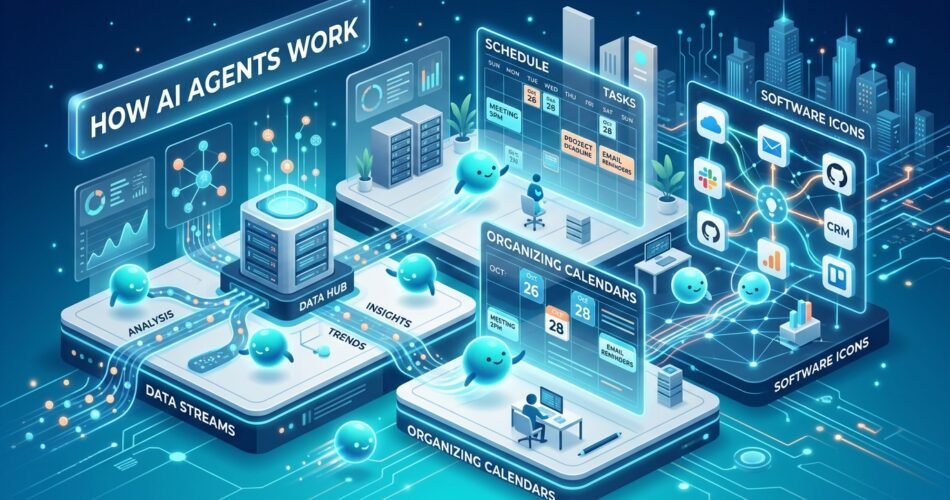
At its core, an AI agent is a system that can perceive information about its environment, reason about a goal, form a multi-step plan, and take actions to achieve that goal, often with only light human supervision along the way. That’s a meaningful upgrade from a standard AI tool, which typically answers one prompt and stops. An agent, by contrast, can break a broad instruction like “research our top three competitors and draft a comparison” into a sequence of smaller steps: searching for information, extracting relevant details, organizing findings, and producing a structured output, all without needing a new prompt for each stage.
The three ingredients that separate an agent from a simple automation script are autonomy, reasoning, and memory. Autonomy means the system can decide how to pursue a goal, not just execute a fixed set of instructions. Reasoning means it can evaluate intermediate results and adjust its approach when something doesn’t work as expected. Memory means it can retain context across steps, and sometimes across sessions, so it isn’t starting from zero every time it’s asked to do something related to a previous task.
The Anatomy of How an Agent Actually Works
Perceiving the Task and Environment
Every agent workflow starts with some form of input, whether that’s a natural language instruction from a person, a trigger from another piece of software, or data pulled from a connected system like a database or an email inbox. This is the agent’s window into what’s actually happening, and the quality of that input shapes everything downstream. A poorly scoped goal tends to produce a meandering, unreliable agent, while a clearly defined one gives the system something concrete to plan against.
Planning and Reasoning Through Steps
Once an agent understands the goal, it needs to figure out a path to get there. This is where the underlying language model does the heavy lifting, breaking a broad objective into an ordered sequence of smaller, achievable actions. Modern agent frameworks often let the system revise this plan mid-task if new information suggests the original approach won’t work, which is a meaningful departure from older automation tools that simply failed when a step didn’t go as scripted.
Taking Action Through Tools
Reasoning alone doesn’t accomplish anything in the real world, which is why agents are typically connected to tools: search engines, code execution environments, databases, APIs, or specific software applications. This is the layer where an agent actually does something, whether that’s querying a customer record, sending an email, updating a spreadsheet, or writing and running a piece of code to test a hypothesis. The range and reliability of these tool connections largely determines what an agent is actually capable of automating.
Checking Its Own Work
The more sophisticated agent systems include a self-evaluation step, where the agent reviews the outcome of an action against the original goal before deciding whether to proceed, retry, or escalate to a human. This reflective loop is part of why agentic systems tend to handle ambiguity better than older rule-based automation, though it’s also far from foolproof, which is a point worth keeping in mind before handing over anything high-stakes.
Where AI Agents Are Already Automating Real Work
Customer Service and Support
Customer service has become one of the clearest proving grounds for agentic AI. Gartner projects that agentic AI will autonomously resolve roughly 80% of common customer service issues without human intervention by 2029, and the trend is already visible in how many companies route routine tickets, refund requests, and account questions through agent-driven systems before a human ever sees them. Conversational agents handling this category of work are also projected to help save around $80 billion in contact-center labor costs, a figure that explains why this is often the first place organizations deploy agentic systems.
Research, Analysis, and Reporting
Agents built for research and analysis can pull data from multiple sources, cross-reference it, and produce a structured report with far less manual assembly than a human analyst would need. This is particularly valuable in finance and insurance, two of the industries currently leading agent adoption, where multi-step data gathering and compliance-related documentation are constant, repetitive burdens on skilled staff.
Software Development
In software teams, agents are increasingly used to handle discrete coding tasks: writing a function, debugging an error, generating tests, or reviewing a pull request against a style guide. What makes this use case compelling is the tight feedback loop. Code either runs correctly or it doesn’t, which gives an agent a clear, immediate signal about whether its work succeeded, making software development one of the more mature and reliable domains for agentic automation.
Marketing and Content Operations
Marketing teams are using agents to manage multi-step workflows that used to require several people and a project manager to coordinate: drafting a campaign brief, generating supporting content, scheduling distribution, and monitoring performance metrics, with the agent adjusting future steps based on what the data shows. This kind of end-to-end orchestration is where agents start to look meaningfully different from the single-purpose AI writing tools most marketers are already familiar with.
The Honest Numbers on Adoption and Risk
It’s worth being clear-eyed about where the industry actually stands, because the reality is more nuanced than the headlines suggest. 62% of organizations are at least experimenting with AI agents, but fewer than 25% have scaled an agentic system to production, a gap that reflects real technical and organizational hurdles rather than a lack of interest. Enterprises that have successfully deployed agents report an average return on investment of around 171%, which is a strong number, but it belongs to the minority that got the integration right.
The failure mode is instructive too. Gartner estimates that more than 40% of agentic AI projects could be shelved by the end of 2027, largely because of rising costs, unclear business value, and insufficient governance rather than any fundamental flaw in the technology itself. The pattern across multiple industry reports is consistent: agents fail most often not because the underlying model isn’t capable, but because the surrounding workflow, data access, and oversight weren’t built out properly before deployment.
What to Watch Before Handing Over the Keys
Anyone considering agentic automation for a real workflow should treat the early stage with the same caution a good manager would use when delegating to a new hire: start with tasks that have low stakes and clear success criteria, build in a human checkpoint for anything irreversible, and expect to iterate on the agent’s instructions the same way you’d coach an employee. 93% of business leaders believe organizations that successfully scale AI agents in the next year will gain a real competitive edge, but that edge tends to go to the teams that treated the rollout as a genuine operational change, not just a tool swap.
Governance deserves particular attention as agent usage grows. An agent that can take real actions, sending emails, modifying records, executing code, carries real risk if it misfires, and the organizations seeing the strongest results are the ones that paired agent deployment with clear rules about what the system is and isn’t allowed to do on its own.
Final Thoughts
AI agents represent a genuine shift in what automation can handle, moving well past the rigid, single-step scripts of the past into systems that can plan, act, and adapt across an entire workflow. The technology is real, the productivity gains being reported are substantial, and the trajectory points toward these systems becoming a standard part of how both individuals and organizations get work done. At the same time, the gap between experimentation and reliable production use is still wide enough that a healthy dose of skepticism, and a clear-eyed plan for oversight, remains the smartest way to approach adoption.
If this breakdown helped make sense of where agentic AI actually stands today, share it with someone weighing whether to bring agents into their own workflow, or leave a comment with the automation you’re most curious to try. And if you want more grounded, well-researched breakdowns like this one as the agentic AI space keeps moving, subscribe so you don’t miss what’s next.

